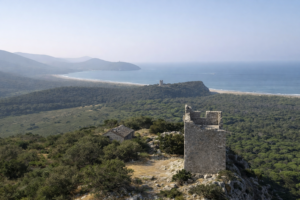
Among the dense pine forests that separate Marina di Grosseto from the sea stand today the remains of Castel Marino, one of the ancient coastal towers built in the 16th century to watch over the Tyrrhenian coast against pirate attacks. Once austere and proud, the tower now blends into the trees and dunes, yet it still preserves an aura of mystery that unsettles those who venture near it at sunset.
Legend tells of Isabella, the young daughter of the commander of the Castel Marino garrison. She was beautiful, educated, and proud, promised in marriage to a Spanish officer chosen by her father. But Isabella’s heart belonged to Lorenzo, a simple fisherman from Principina, whom she met in secret among the reeds at the mouth of the Ombrone River.
When her father discovered the forbidden love, he reacted harshly: he confined Isabella to the tower and ordered Lorenzo’s arrest. Desperate, the young woman managed to escape one winter night and headed for the beach to reunite with her beloved. But a violent storm struck the coast, and the waves overwhelmed the boat on which the two were trying to flee.
The sea returned Lorenzo’s body, but Isabella was never found. Since then, according to the tales of fishermen and shepherds, a female spirit appears among the ruins of the tower on windy nights. She wears a long white dress and gazes out to sea with a sorrowful look, as if still waiting for her lover’s return.
Many say that the flickering lights among the pine trees are the reflection of her veil, and that her weeping mingles with the rustle of the mistral wind. Some even claim that, on certain summer nights, the ghost has been seen walking among the dunes, leaving footprints that vanish at dawn.
🗺️ Historical note:
The Tower of Castel Marino truly existed and was part of the defensive system commissioned by the Medici to protect the Maremma coast. It maintained visual communication with other towers such as Trappola, San Rocco, and the Fortress of Castiglione. The area was often the scene of Barbary raids, but also a refuge for fishermen, charcoal burners, and butteri (local cowboys).